
Personal agents shift the interaction from "answer my question" towards "help me get this done". Rather than ending with advice, they can help carry a task through research, preparation and follow-up, with the person setting the goal and retaining control of consequential decisions.
Meta's Muse describes this direction as proactive help with tasks, projects and longer-term goals, offering ideas and acting under your direction. My experience with Instinct brings that idea down to an everyday example: preparing a car for sale. This is not a comparison of the two products; Muse provides context for the broader direction, while the hands-on experience below is with Instinct.
I gave Instinct a very ordinary task: help me sell my car.
The interesting part was not how quickly it could fill in a form. It was what happened when a reserve price, an auction deadline and two apparently conflicting explanations of the rules met.
I used Instinct as my personal agent to research valuations and prepare a Carwow listing. It also identified a minor dent and a scuff in two places on the car from the photographs. I kept control of the decisions. In the end, I closed the listing before the auction ran.
No sale is claimed in this case study. That is precisely why it is worth discussing: useful automation is not always about finishing a transaction. Sometimes it is about making an unresolved risk visible before you commit.
In short
- The task: Value a used diesel SUV and list it for dealer auction.
- The constraint: I set a minimum price and would not sell below it.
- The agent: Instinct, helping with research, photo-based identification of minor damage and listing preparation.
- Who decided: Me, at every commitment point.
- The outcome: I closed the listing before the auction ran.
This is an account of using a personal agent, not an implementation guide to Instinct's internals. The engineering lessons below are patterns drawn from the workflow, not claims about the product's architecture.
The problem: four numbers, four meanings
Selling a used car online looks like a form to fill in. In practice, it is a chain of small decisions where a misread number or term can cost real money.
A site shows an estimate before anyone has seen the car. A reserve is the minimum a seller sets. A bid is an offer. Fees come off the end. Each platform defines these a little differently, and the definitions sit in different documents.
| Number | What it means | What to check |
|---|---|---|
| Estimate | A guide based on the information supplied so far. | It is not a promise or a guaranteed floor. |
| Reserve | A minimum set for the auction. | Whether reaching it creates a commitment depends on the platform's terms. |
| Offer | What a buyer says they would pay. | Some platforms treat it as non-binding until confirmation; do not assume all do. |
| Net proceeds | The offer minus applicable fees. | This is the number that must clear the owner's minimum. |
These are conceptual distinctions, not a statement that every marketplace uses the same rules.
A person can read all of this. The difficulty is doing it carefully, under a deadline, while an auction clock runs. That made it a useful real-life test of an agent: not just retrieving information, but keeping the original constraint in view as the task progressed.
The workflow: delegate the preparation, retain the decision
Instinct's work fell into four stages. The first three were research and preparation. The fourth belonged to me.
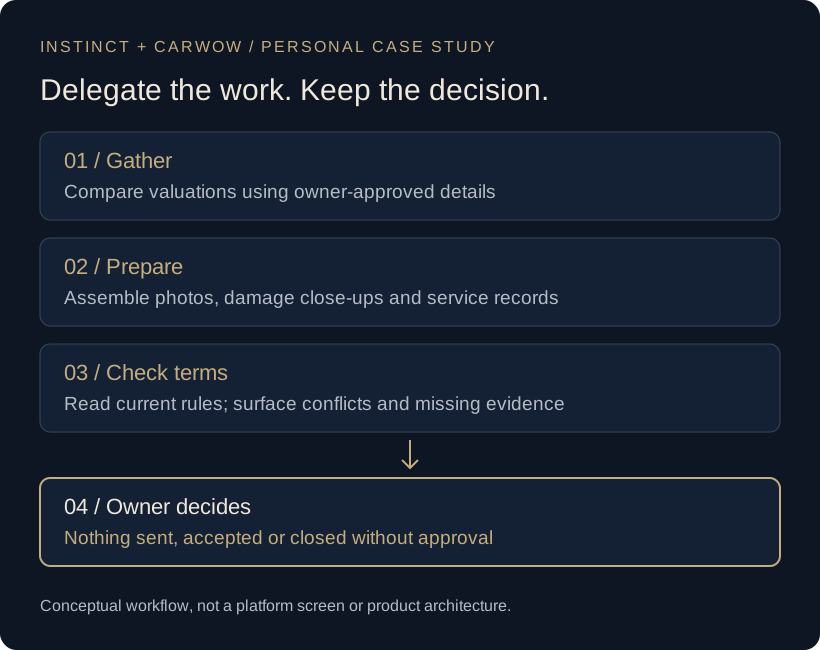 Conceptual workflow: Instinct gathers valuations, prepares listing evidence and checks terms; the owner decides whether to proceed. This is a diagram, not a Carwow screen.
- Gather: Compare instant-offer valuations using details I approved.
- Prepare: Assemble photos, damage close-ups and service records for the listing.
- Check terms: Read the rules that determine what a price or a bid commits the seller to.
- Decide: I accept, decline or change course.
The decision gate: nothing is accepted, closed or sent without my approval.
Gather
I approved a small set of contact details for instant-offer sites. Instinct collected valuations from several of them, including Carwow. I compared these with a dealer part-exchange figure that came in far lower.
That is a natural division of labour. The agent does the repetitive reading and comparing; the owner decides which route is worth pursuing. Permission to use specific details for a valuation is not blanket permission to submit them anywhere or agree to a sale.
Prepare
I asked for close-up photos of every dent and the service history to go into the Carwow listing. That was deliberate: disclose the damage up front rather than leave room for a dealer to discount for it later.
Instinct identified a minor dent and a scuff in two places on the car from the photographs. That made the photo review a practical part of preparing an accurate condition description, not just organising images.
It assembled the material and checked it against my disclosure instruction, and the listing went in for approval.
The original submission-time screenshots could not be recovered, so I am not presenting a reconstructed listing as evidence. The redacted capture later in this article shows the listing's subsequent closed state only.
Three moments that mattered
1. A reserve that could not be edited
After the platform's approval call, the reserve on record was below my minimum. The platform then said that a reserve could not be changed once a listing was approved.
I chose a higher reserve and wrote to Carwow myself rather than have the agent send anything. Carwow's reply confirmed that it could not be changed.
The engineering lesson is subtle: the user's constraint and the platform's recorded state are different things. Remembering my minimum was not enough. The workflow had to compare that minimum with the reserve actually on record.
2. Two documents that appeared to disagree
On auction day, 5 October 2026, Instinct read Carwow's terms. As read then, the help pages said a seller was never obliged to accept an offer, while the seller terms said a bid that met the reserve could win automatically and bind the seller.
Instinct reported the conflict instead of guessing which explanation would apply. It checked the live listing, saw a close-listing option and no seller fee, and set out two options:
- Leave it running and risk a sale below my minimum.
- Close it before the auction ran.
It also said what it had not found: an account of what happens if a seller refuses a winning bid.
The supplied case-study material records a further check on 15 October 2026. It describes the same apparent tension between the help topic on cars on sale, which said there was no obligation to accept an offer, and the reserve-price guidance, which said the highest bidder wins if the reserve is met or exceeded, with commitment subject to the dealer's inspection. That guidance also said sellers generally could not change an approved, live reserve alone and should contact Carwow.
This is a dated account of the wording encountered, not legal advice or a claim about the rules today. Marketplace terms and help pages change. Read the current terms and ask the platform to clarify any uncertainty before relying on them.
For an agentic workflow, the important behaviour was not producing the most confident answer. It was separating source evidence, conflicting interpretations and missing information.
3. The decision stayed human
Instinct did not touch the listing without my approval. I closed it before the auction ran.
A wrong assumption about the terms could have meant a binding sale below my minimum. I chose not to take that risk. The listing now shows as closed.
 Redacted capture supplied for this case study, dated 15 October 2026: the Kia Sportage listing is marked Closed. Registration blurred. This is not a screenshot from the original submission or auction day.
This capture supports one narrow observation: the listing is closed. It does not prove a sale, an achieved price, a time saving or a financial return.
The same discipline applied on a second marketplace, where I submitted my own listing. When a headline figure was ambiguous, Instinct asked me to open a help tooltip and send back its exact wording. That showed the figure was an estimate, not a floor. It also corrected a fee figure it had initially quoted from a range after finding that a flat fee applied in that price band.
The upside: less admin, a more truthful listing
The potential is bigger than comparing valuations. A personal agent can help turn a scattered collection of photos, documents and messages into a consistent, reviewable account of what is actually being sold.
Photo-based damage identification happened in this case: Instinct identified a minor dent and a scuff in two places from my photographs. The broader workflow ideas below are potential extensions, not a claim that every capability described was demonstrated in this example.
Photo-assisted identification of dents and scuffs
In my case, Instinct's identification of the minor dent and scuff showed a concrete advantage of a personal agent: helping surface visible condition details that matter to an honest listing.
Building on that, an agent with suitable image-analysis capabilities could flag other possible dents, scuffs, scratches or wheel damage for the owner to check. It could organise observations by panel, link each one to its source photograph and request another angle where the evidence is unclear. Those additional capabilities were not established by this case study.
As an illustrative example, not the wording or location reported in my case, a draft observation might read: "Possible scuff on the rear-left bumper; please confirm with a close-up." That is more useful, and more honest, than confidently labelling a reflection as damage.
Once the owner confirms an observation, the agent could incorporate it into the listing's condition description and attach the relevant photo. The owner should also add known defects that are not visible in pictures. No visible damage detected is not the same as no damage present: lighting, dirt, perspective and image quality can hide defects, and photographs cannot establish mechanical condition.
The aim is truthful disclosure, not an automated certificate of condition. Keep the original photos, distinguish machine suggestions from owner-confirmed facts, and never retouch damage out of listing evidence.
Less repetitive administration
A personal agent could maintain one owner-approved vehicle record, rather than repeatedly asking for the same details. From that record, it could help:
- Draft marketplace-specific descriptions without contradicting the agreed condition report.
- Check which photos and documents are missing before submission.
- Summarise buyer questions and prepare responses grounded in the approved record.
- Track appointments, outstanding requests and handover tasks.
- Compare offers on net proceeds, not just the headline number.
These activities could reduce copying, chasing and context-switching. Submission, disclosure of additional personal data and any commitment would still need approval. None of these time savings was measured in my example.
A better route to a successful transaction for everyone
An accurate listing gives the seller a clearer account of what they have disclosed, gives the buyer or dealer better information for pricing and inspection, and gives the marketplace a more consistent record to work from.
That could mean fewer avoidable surprises, repeated questions or late renegotiations, helping a suitable transaction progress more smoothly for all parties. It cannot guarantee agreement, a better price or a completed sale.
The goal is not to sell at any cost. It is to help the right transaction complete on terms everyone understands. In my case, that meant stopping; in another case, the same preparation could support a successful sale.
Another everyday use case: rental inventory check-in and check-out
Property inventories have much the same shape: lots of photographs, repeated descriptions, missing context and consequences if the record is wrong.
A landlord, tenant or inventory clerk could use a personal agent to assemble a room-by-room check-in record, then compare it with the check-out evidence at the end of the tenancy. A practical workflow could look like this:
- Capture a baseline: Collect dated room photos, an inventory of furnishings, meter readings and a key count. Record existing marks, wear and defects before move-in.
- Draft the inventory: Group evidence by room and item. Flag possible stains, scuffs or missing items for inspection, with a link back to each source image.
- Review together: Give landlord and tenant an opportunity to inspect, correct and acknowledge the record. Preserve disputed observations rather than treating silence as agreement.
- Compare at check-out: Match like-for-like views and identify possible changes. Ask for more evidence where lighting, furniture placement or camera angle prevents a reliable comparison.
- Prepare the handover: Summarise agreed changes, outstanding maintenance, meter readings and returned keys for human sign-off.
The advantage is a more organised, transparent record for both landlord and tenant, with less manual sorting and fewer opportunities to confuse an old mark with a new one.
The boundary matters here too. An image comparison cannot by itself establish when damage occurred, who caused it, whether it is fair wear and tear, or whether a deposit deduction is justified. The agent should support evidence gathering, not decide liability or automatically withhold money. Applicable tenancy rules and any formal dispute process still govern those decisions.
Property photos can also expose occupants, belongings and private documents. Obtain appropriate permission, minimise what is captured or shared, restrict access and agree how long records will be kept. A personal agent should not turn an inventory exercise into unnecessary surveillance.
Other personal-agent use cases worth exploring
These are further ideas, not outcomes demonstrated by this Carwow experience:
- Selling second-hand furniture or electronics: Turn photos and owner-confirmed specifications into an honest condition report, collect missing details and coordinate collection. Never infer that an appliance is safe or functional from its appearance.
- Home repairs and contractor quotes: Assemble an approved photo brief, compare scope and exclusions across quotes, and track appointments. A person still approves the contractor, access arrangements and spend.
- Warranty or insurance claim preparation: Organise receipts, a factual timeline and supporting images; flag missing evidence and draft correspondence. Do not invent a cause, value or date, and require review before submission.
- Moving home: Track inventory, removals quotes, packing tasks and address-change drafts. Keep payments, bookings and disclosure of the new address behind explicit approval.
The common advantage is continuity: one place to organise evidence, remember constraints and carry the administrative work forward, without handing over the final decision.
Five engineering patterns worth taking away
The workflow is personal, but the control problems are familiar to anyone building automation.
State the decision rights up front
The objective was not simply "sell the car". It was to explore a sale without going below my minimum, with approval required at commitment points.
That difference matters. An agent optimising for task completion alone might treat a live listing or an accepted bid as success. The owner's actual objective includes constraints that can make stopping the correct result.
Put a human gate before consequential actions
Research and drafting can be delegated within the agreed scope. Sending a message, changing a live listing or accepting a bid needs explicit approval.
Approval should relate to the specific action and the state currently on screen. An earlier instruction to investigate a sale should not be treated as permission to accept a later offer.
Keep evidence separate from interpretation
"The help page says this" is not the same as "this is definitely the contractual outcome".
When two sources appear inconsistent, the workflow should preserve that disagreement and name the uncertainty. It should not silently choose whichever interpretation makes the next step easiest.
Ask for the exact wording
When the second marketplace's headline number was unclear, the useful next action was a precise request for the tooltip text.
That is a better recovery strategy than repeatedly reasoning over an ambiguous label. The missing input was evidence, not a more elaborate answer.
Correct yourself visibly
The fee correction mattered because it changed the net-proceeds calculation.
For a consequential workflow, a correction should make clear what changed and which earlier conclusion needs revisiting. Quietly replacing a number is not enough if the user may already have acted on it.
A reusable control model
The following is an illustrative design checklist, not the actual prompt used with Instinct and not executable configuration for it:
text1Objective: 2 Explore a sale while protecting the owner's minimum net proceeds. 3 4Inputs: 5 Owner-approved vehicle details, photos and service records. 6 Current valuation evidence and the platform's recorded reserve. 7 Current terms, applicable fees and unresolved questions. 8 9Delegated work: 10 Research, compare, assemble evidence and draft next steps. 11 12Approval required: 13 Sharing additional personal data, sending messages, 14 changing or closing a listing, and accepting any offer. 15 16Pause and escalate: 17 The recorded reserve conflicts with the owner's constraint. 18 Source documents disagree about a commitment. 19 Fees or the meaning of a displayed figure remain unclear. 20 21Completion: 22 Record the owner's decision and verify the resulting state. 23 Do not report a listing, estimate or bid as a completed sale.
In software terms, the useful invariant is that the workflow must not proceed into a sale commitment while the owner's minimum or the applicable terms remain unresolved. This is a recommended control pattern drawn from the experience, not evidence that Instinct implements a formal policy engine.
Why this matters beyond selling a car
The same shape appears in invoice queries, vendor onboarding and change approvals:
- Agree the outcome and the limits first.
- Let automation do the reading, assembling and comparing.
- Keep a named person at each commitment point.
- Verify what actually happened before declaring success.
This personal example does not establish enterprise performance, cost savings or return on investment. It does make the control boundary tangible: delegating work does not mean delegating authority.
At Kanak Systems, we approach delivery through pre-agreed, measurable outcomes, from ideation and solution design to production. If you are exploring where agents can help without removing accountability, let's discuss your workflow.
For a complementary technical example of evidence and explicit gates, read how we enrich Copilot's context for agentic code review. For the broader design perspective, see building an intelligent multi-agent system.
The takeaway
I started with "help me sell my car". I finished with a clearer lesson about personal agents.
The valuable part was not an agent acting without me. It was an agent helping me understand when not to proceed.
Where would you draw that boundary in your own workflow: what would you delegate, and what would always need your approval? Use Share on LinkedIn at the top of this article to add your perspective.
Disclosure: I used Instinct as the personal agent in this account. Kanak Systems did not build the assistant and has no connection with Carwow or the other marketplaces discussed. This article describes a personal experience, not a product endorsement or legal advice. Terms and fees are time-sensitive; check current platform guidance before acting. Personal details and prices are omitted, and the visible vehicle registration in the supplied capture is blurred.